
The Human Connection Paradox: When Technology Begins to Replace What Keeps Us Healthy
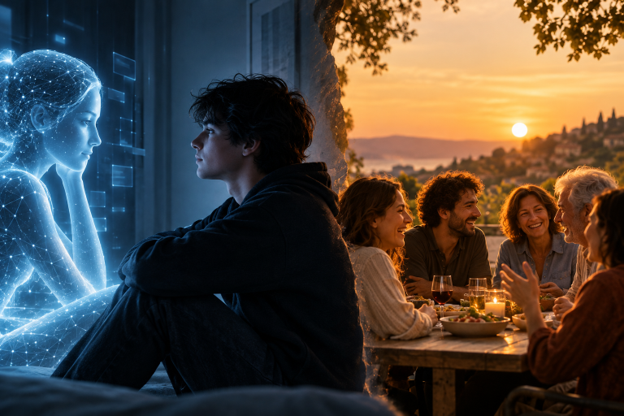
We are living through one of the most extraordinary periods of technological advancement in human history.
Artificial intelligence can already analyze medical images, recognize patterns in enormous datasets, assist physicians with diagnosis, accelerate drug discovery, translate languages almost instantaneously, and make sophisticated information available to virtually anyone with a smartphone.
I believe much of this is enormously promising.
But there is a question we are going to have to ask with increasing urgency:
What happens when technology stops helping us live our lives and begins replacing some of the experiences that make us human?
That question has become particularly relevant with the rapid emergence of AI companions—artificial intelligence systems designed not simply to answer questions but to behave like friends, confidants, romantic partners, and increasingly intimate companions.
The technology is remarkable.
The biological implications may be considerably more complicated.
Because human connection isn't simply something that makes life pleasant.
It appears to be part of the machinery that keeps us healthy.
We Are Social Organisms
For most of human history, survival depended upon belonging to a group.
Our ancestors hunted together, gathered food together, raised children together, protected one another, and cared for older members of the community. Isolation wasn't simply emotionally uncomfortable. It could be dangerous.
Our biology developed in that environment.
Thousands of years later, we still carry much of that biology with us.
We respond physiologically to touch, conversation, affection, friendship, belonging, and social support. Conversely, chronic loneliness and social isolation have been associated with poorer health outcomes, including cardiovascular disease, cognitive decline, depression, and premature mortality.
This is why I have long considered connection one of the foundations of healthy aging.
We frequently discuss longevity in terms of biomarkers.
Blood pressure.
Cholesterol.
Glucose.
Body composition.
VO2 max.
Inflammatory markers.
All are important.
But there are other questions worth asking.
Who do you eat dinner with?
Who would you call if something went wrong?
Who depends upon you?
Who makes you laugh?
Where do you belong?
These questions can sound almost sentimental compared with the sophisticated measurements of modern longevity medicine.
They aren't.
They may be biological questions.
The Longevity Lesson We Already Know
Some of the world's longest-lived populations have attracted enormous scientific attention.
Researchers have examined their diets, activity levels, genetics, environments, and lifestyles. There is no single formula that explains longevity, and we should be cautious about reducing complex populations to a handful of lifestyle rules.
But one characteristic appears repeatedly.
People remain connected.
During my time in Italy, I have seen this expressed in remarkably ordinary ways.
People walk through town and encounter neighbors they have known for decades. Meals become social events rather than nutritional transactions. Older people remain visible members of communities.
Families often maintain strong intergenerational relationships. The piazza, café, church, market, and neighborhood create repeated opportunities for human interaction.
None of this looks particularly technological.
And that may be precisely the point.
We have spent billions searching for interventions that might extend human life while gradually engineering ordinary human interaction out of daily life.
We order groceries without speaking to anyone.
We work from home.
We exercise with headphones.
We eat while looking at screens.
We text instead of calling.
We stream entertainment alone.
We use automated checkouts.
We have hundreds or thousands of social-media "connections" while sometimes knowing surprisingly little about the people living next door.
Now we are approaching another threshold.
We can have relationships without another human being at all.
The Perfect Companion May Be an Imperfect Idea
AI companions present a fascinating psychological proposition.
Imagine a companion who is always available.
It remembers what you tell it.
It listens without becoming distracted.
It doesn't have somewhere else to be.
It can be encouraging when you're discouraged and sympathetic when you're upset.
It may eventually know your preferences extraordinarily well.
For someone who is lonely, elderly, isolated, disabled, or simply going through a difficult period, it isn't difficult to imagine how such technology might provide comfort.
We should acknowledge that possibility rather than dismiss it.
But there is another side to the equation.
Human relationships aren't efficient.
People misunderstand us.
They disagree with us.
They have competing needs.
They disappoint us.
Sometimes we disappoint them.
Relationships require compromise, patience, forgiveness, empathy, communication, and occasionally the uncomfortable recognition that we are wrong.
Those difficulties aren't defects in human relationships.
They are part of what relationships teach us.
A machine designed primarily around the needs and preferences of its user changes that equation.
It may simulate a relationship extraordinarily well while removing many of the demands that make relationships developmental.
And that distinction becomes particularly important for children and adolescents.
Growing Up Requires Other People
Adolescence isn't simply a period during which the body matures.
It is a period of intense social development.
Young people learn how to interpret other people's emotions, negotiate disagreements, experience rejection, establish boundaries, recover from embarrassment, develop romantic relationships, and gradually understand that other people possess needs and perspectives different from their own.
Much of this learning is uncomfortable.
Anyone who remembers adolescence knows that.
The awkward conversation.
The invitation that wasn't accepted.
The first date.
The argument with a friend.
The breakup.
The apology.
The realization that saying exactly what you want doesn't necessarily produce the outcome you want.
These experiences can hurt.
But removing every source of discomfort from human development doesn't necessarily create healthier humans.
Sometimes discomfort is the stimulus for adaptation.
That is a principle we already understand biologically.
Exercise stresses muscle and makes it stronger.
Weight-bearing activity stresses bone and helps preserve it.
Heat and cold can activate adaptive responses.
Intellectual challenge helps maintain cognitive capacity.
In biology, appropriate challenge often produces resilience.
Why would emotional development be entirely different?
A young person whose primary companion never rejects them, never becomes impatient, and continually adapts to their preferences may receive comfort without necessarily developing the skills required to maintain relationships with actual people.
The concern isn't that AI can talk.
The concern is what happens if talking to AI becomes easier than talking to humans.
Connection Is Not the Same as the Feeling of Connection
This distinction may become increasingly important.
Technology is becoming extraordinarily good at producing experiences that resemble biological rewards.
Ultra-processed foods can deliver intense combinations of sweetness, salt, fat, and texture.
Social media can deliver rapid bursts of novelty and social validation.
Digital entertainment can provide endless stimulation.
AI may now be able to provide something even more powerful:
the perception of companionship.
But satisfying a biological desire isn't necessarily the same thing as fulfilling the biological need that created it.
An ultra-processed snack can stimulate our appetite pathways without providing the nutritional qualities of whole food.
Scrolling through hundreds of social-media posts can stimulate our interest in other people without necessarily producing meaningful friendship.
Similarly, an AI conversation might alleviate the immediate sensation of loneliness without reproducing everything that occurs when two human nervous systems interact in a genuine relationship.
That distinction deserves serious scientific attention.
We need to understand not simply whether people report feeling less lonely while using AI companions, but what happens over years.
Do these systems encourage people to reconnect with others?
Or do they gradually make human relationships seem unnecessarily difficult?
Do they help socially isolated older adults engage with the world?
Or do families begin visiting less because "Grandma has her AI companion"?
Do adolescents use AI to work through difficult social situations and then return to their peers?
Or do they retreat into relationships where rejection has effectively been programmed away?
The answers will matter.
The Same Question Applies to Healthcare
There is a parallel here with medicine.
AI is going to become deeply embedded in healthcare.
That is almost inevitable, and in many respects desirable.
AI can potentially reduce administrative work, identify patterns physicians miss, improve diagnostics, personalize treatment, and allow clinicians to spend less time staring at computers.
That could make healthcare more human.
But the opposite outcome is also possible.
We could use technology to replace increasingly large portions of the human relationship between clinician and patient.
Those are two very different futures.
The question isn't whether AI belongs in healthcare.
It does.
The question is what we ask it to replace.
If AI handles paperwork so a physician can spend another ten minutes talking with a frightened patient, technology has increased human capacity.
If AI becomes the person the patient talks to because human interaction is considered inefficient, we may have gained efficiency while losing something medicine was supposed to preserve.
The same principle should guide our thinking about AI companions.
Technology should expand human capacity, not diminish the need to use it.
Longevity Is More Than Staying Alive
This brings us back to the larger longevity conversation.
We are becoming increasingly capable of extending life.
Medicine can replace joints, open arteries, treat cancers, control infections, implant devices, modify immune responses, and increasingly intervene in biological processes that once seemed untouchable.
The coming decades may bring even more extraordinary breakthroughs.
But the objective of longevity cannot simply be maintaining biological existence for as many years as possible.
The objective should be preserving the capacity to live.
To move.
To think.
To contribute.
To love.
To participate.
To remain connected to other people.
This is the distinction between lifespan and healthspan that is sometimes lost in our fascination with longevity technology.
A longer life without relationships, purpose, independence, or engagement is a very different achievement from a longer life that preserves them.
Technology may help us achieve the latter.
But only if we remember what we're trying to preserve.
We Shouldn't Fear AI. We Should Define Its Role.
Every transformative technology produces understandable anxiety.
We shouldn't respond by assuming that everything new is dangerous.
AI companions could eventually have valuable roles.
An isolated older adult might use an AI system that encourages her to call her daughter, reminds her about a community event, notices changes in speech that warrant medical attention, or helps her arrange transportation to see friends.
A teenager struggling socially might use AI to rehearse a difficult conversation before having it with a classmate.
Someone experiencing grief might find temporary comfort during the middle of a sleepless night when no one else is available.
Those are examples of technology serving human connection.
The problem begins when the bridge becomes the destination.
We should be designing AI that pushes us back toward the world rather than quietly replacing it.
An AI companion should ideally say:
Call your friend.
Go outside.
Join the group.
Talk to your spouse.
Visit your mother.
Ask someone to dinner.
You need another person right now, not me.
That may ultimately be one of the most important ethical design principles for artificial intelligence.
Protecting the Extraordinary by Preserving the Ordinary
There is an irony running through much of modern longevity.
We are searching for extraordinary interventions while neglecting remarkably ordinary ones.
We investigate molecules associated with aging while millions of people remain sedentary.
We develop sophisticated nutritional supplements while consuming diets dominated by ultra-processed food.
We study sleep optimization while bringing glowing screens into bed.
We build technologies designed to connect the entire planet while loneliness remains a significant social problem.
And now we may create artificial companions sophisticated enough to convince us that we are no longer alone.
Perhaps they will help.
But we should remember something fundamental.
Human beings didn't evolve merely to receive words of affirmation.
We evolved to belong to one another.
The friction of human relationships—the disagreements, obligations, compromises, laughter, affection, frustrations, forgiveness, and vulnerability—isn't an unfortunate inefficiency that technology needs to eliminate.
It is part of being human.
The future of health will undoubtedly involve artificial intelligence.
The future of longevity will involve remarkable science.
We should welcome both.
But the measure of technological progress shouldn't simply be how many human activities machines can replace.
It should be whether technology allows human beings to become healthier, more capable, more connected, and more fully alive.
The extraordinary future we are building may depend upon protecting some very ordinary things.
A shared meal.
A conversation.
A friendship.
A hand held during a difficult moment.
A family sitting around a table.
A community in which people know one another.
A life in which we are needed by someone other than ourselves.
Those experiences don't look like longevity medicine.
But they may be among its most powerful ingredients.
And no matter how intelligent our machines become, we should be very careful before deciding they are adequate substitutes for one another.