
Vitamins Without the Hype: What They Are, What They Do, and What We Get Wrong
By Eugene Antenucci, DDS

Walk through a pharmacy or scroll through social media, and vitamins can seem like an answer to almost everything: fatigue, poor sleep, aging skin, forgetfulness, even the fear that we are somehow failing at being healthy. The messages are persuasive because they begin with something true. Vitamins are essential to life.
The confusion begins when that truth becomes a sales pitch. Needing a nutrient does not automatically mean needing a supplement. And a vitamin’s role in keeping us healthy does not establish that taking extra will make us healthier.
Understanding vitamins starts with separating what the body requires from what a product promises.
What exactly is a vitamin?
Vitamins are organic compounds—substances containing carbon—that the body needs in small amounts to function normally. They help maintain tissues and support the chemical reactions that keep us alive. Unlike carbohydrates, fats, and proteins, vitamins do not supply calories. They help the body use the fuel and materials it receives.
There are 13 recognized essential vitamins: A, C, D, E, K, and eight B vitamins. Minerals, including calcium, iron, and magnesium, are also essential nutrients, but they are elements, not vitamins. A bottle containing both does not make them the same thing.[1]
Think of vitamins as necessary participants in a complicated construction project. Some help workers use materials; others help maintain the structure. A missing participant can disrupt the job. Adding more participants after every role is filled does not necessarily improve the result.
The alphabet has a purpose
Vitamin charts offer a useful introduction, but their short descriptions can make these nutrients seem simpler than they are. Most vitamins have several jobs, and many jobs require several nutrients working together.
Vitamin A supports vision, immune function, and the maintenance of tissues such as skin. Animal foods, including eggs and dairy products, provide preformed vitamin A. Carrots, pumpkin, and dark leafy greens provide compounds the body can convert into vitamin A. These are related sources, but they are not chemically identical.[1,2]
The eight B vitamins are a family, not a single substance. B1 is thiamine; B2, riboflavin; B3, niacin; B5, pantothenic acid; B6, pyridoxine and related compounds; B7, biotin; B9, folate; and B12, cobalamin. B3 and B5 sometimes disappear from simplified charts, but both belong on the list.[1]
Collectively, B vitamins support food metabolism, nerve function, and cell maintenance, though their individual roles differ. Thiamine helps the body use carbohydrates. Folate is needed to make DNA and support cell division. B12 helps maintain nerves and produce healthy red blood cells.[1,3]
Foods supplying various B vitamins include beans, lentils, whole or enriched grains, eggs, dairy, fish, and meat. No single food supplies every vitamin in the proportions everyone needs. B12 deserves particular attention because its natural food sources are primarily animal foods; fortified foods provide another source.[1,3]
Vitamin C helps the body make collagen, the structural protein found in skin, gums, blood vessels, and other tissues. It also helps absorb iron from plant foods and contributes to immune function. Citrus fruits are familiar sources, but peppers, kiwi, and broccoli also supply it.[4]
Vitamin D helps the body absorb calcium and supports bone health. Fatty fish and certain fortified foods provide it, and the skin can manufacture it in response to sunlight. Sunlight is therefore a production trigger, not a food source. Production varies, so time outdoors does not reliably establish someone’s vitamin D status.[1,5]
Vitamin E helps protect cell components from oxidative damage; nuts, seeds, and vegetable oils are sources. Vitamin K participates in normal blood clotting and bone-related processes, and leafy greens supply it. Their functions are essential, but describing a function is not evidence that extra intake improves it.[12,13]
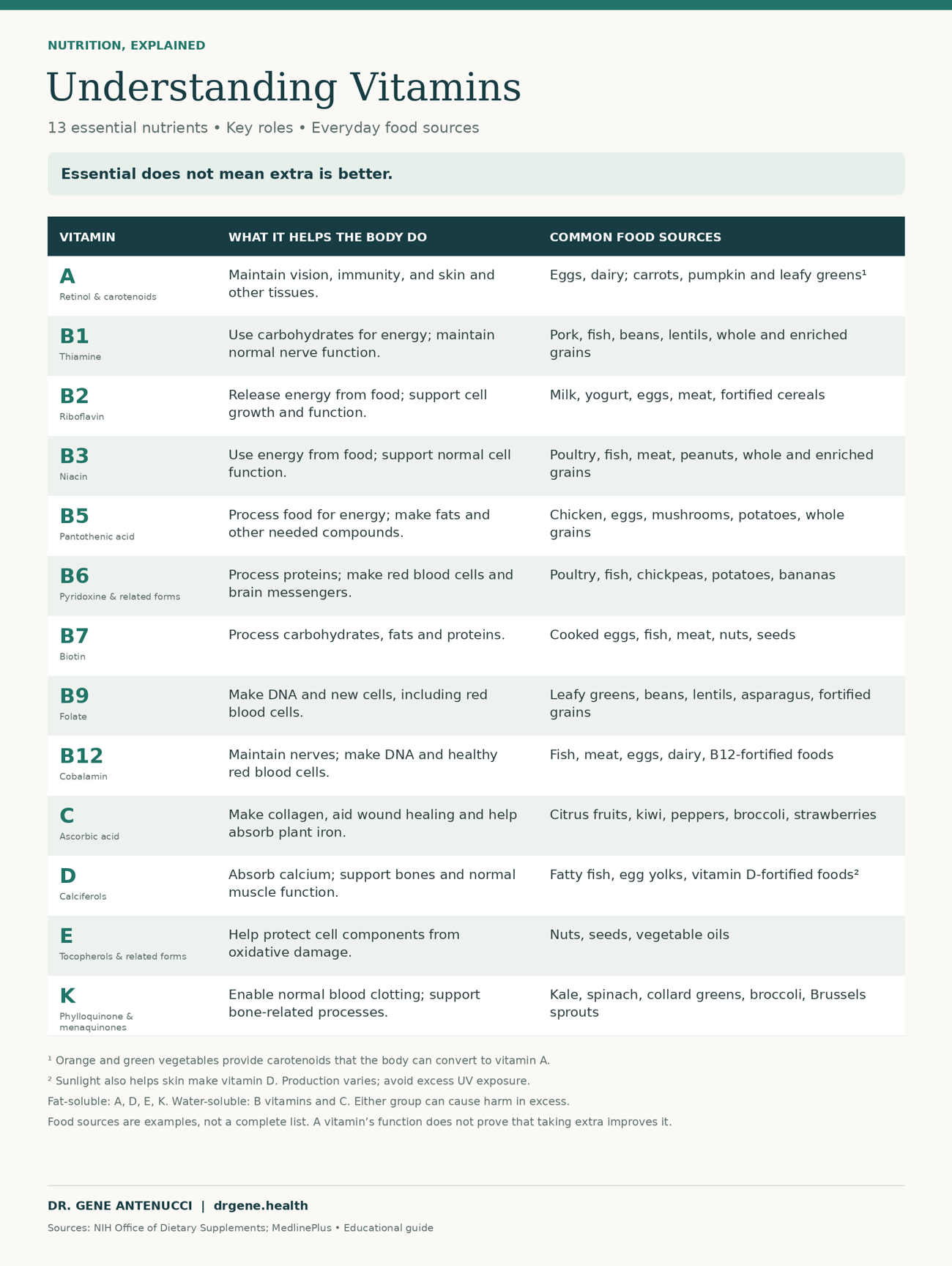
Click photo to enlarge.
Why “water-soluble” does not mean harmless
Vitamins fall into two broad groups. A, D, E, and K are fat-soluble: dietary fat helps their absorption, and the body can store them. The B vitamins and vitamin C are water-soluble. Excess amounts of many water-soluble vitamins leave through urine, although storage and handling vary. B12, for example, can remain stored for years.[1]
This distinction helps explain biology. It is not a safety guarantee.
Excessive supplemental B6 can damage nerves, even though it is water-soluble. Too much vitamin D can raise blood calcium to dangerous levels and harm the kidneys. Large amounts of preformed vitamin A can damage the liver and cause birth defects. The relevant questions are which vitamin, which form, how much, and for how long.[5,6,7]
“Your body gets rid of what it does not need” is therefore an incomplete explanation. A nutrient can cause harm before, or despite, its elimination.
Deficiency and enhancement are different questions
When someone lacks a vitamin, restoring an adequate supply can make a substantial difference. That does not mean the same intervention helps someone who already has enough.
B12 illustrates the distinction. Deficiency can cause anemia, fatigue, and neurological problems. Correcting it matters. Yet B12 supplementation has not been shown to improve energy or endurance in people whose intake is already adequate.[3]
The same reasoning should guide how we read claims about immunity, skin, and sleep. “This vitamin participates in a process” and “taking this product improves that process” are separate statements. The second requires evidence of an actual benefit in people.
A chart claiming that B6 “improves sleep,” for example, goes beyond explaining its established nutritional functions. Evidence would need to identify who benefited, at what dose, and under what circumstances. A biochemical connection alone cannot answer those questions.
How much is enough?
Nutrition recommendations reflect age, sex, and life stage. Pregnancy, illness, medications, and absorption problems can change the assessment. No single vitamin prescription fits everyone.[7,8]
The Recommended Dietary Allowance, or RDA, is an intake intended to meet the needs of nearly all healthy people in a particular group. The Daily Value on a label is a standardized reference that makes products easier to compare. It is not a personalized assessment.[8,9]
Likewise, 500 percent of the Daily Value does not mean five times the health benefit. It describes an amount relative to a reference number.
For many nutrients, an upper intake limit identifies an amount above which the risk of harm increases. It is a safety boundary, not a target. The absence of an established limit for another nutrient does not demonstrate that unlimited amounts are safe.[7,8]
Food, supplements, and the missing context
A vitamin is a nutrient. A supplement is a product that may contain that nutrient. Keeping those definitions separate prevents much of the confusion surrounding this subject.
Food delivers vitamins alongside other components, including protein, fiber, minerals, and fats. A vitamin tablet cannot reproduce an entire dietary pattern. That is why evaluating nutrition requires looking beyond a list of isolated ingredients.[8]
A varied whole-food diet can go a long way toward meeting the body’s vitamin needs without extensive supplementation. Vegetables, fruit, beans, whole grains, nuts, seeds, fish, eggs, and other animal foods provide a broad range of vitamins. Dietary fats—including those naturally present in fish, eggs, and dairy—also help the body absorb vitamins A, D, E, and K. Sunlight contributes to vitamin D production, although its effects vary with age, skin pigmentation, season, and location; extra sun exposure is not a reliable or risk-free substitute for adequate intake. For many people, eating well provides a strong nutritional foundation, while supplements address specific needs rather than serve as a routine collection of “just in case” products.[9]
Still, dismissing every supplement would be as misleading as promoting one to everyone. A documented deficiency, impaired absorption, a restricted diet, or pregnancy-related needs can create a specific reason for supplementation. Folic acid around conception, for instance, has anestablished role in reducing neural tube defects.[10]
The useful question is what need is being addressed. A defined nutritional problem deserves a defined response. General anxiety about health is a poor substitute for that assessment.
It also helps to notice how a message is framed. Does it explain a nutrient, or make you feel incomplete without a purchase? Does it acknowledge uncertainty, or offer certainty where the research remains mixed? Education should leave readers better able to judge a claim. Marketing often leaves them feeling they need the product before they understand the problem. Recognizing that difference does not require a science degree. It requires slowing down long enough to examine what is actually being promised.
Reading the promises more carefully
In the United States, dietary supplements are regulated, but the FDA does not approve them for safety and effectiveness before they reach the market. A product’s availability is therefore not proof that its advertised benefits have been demonstrated.[11]
Language deserves scrutiny, too. “Supports normal immune function” describes a broad relationship. It does not establish that a product prevents infections. “High potency” describes concentration, not necessarily usefulness. “Natural” does not establish safety.[11]
Research headlines need context: Were participants deficient? Was the study conducted in people? Did researchers measure symptoms and health outcomes, or only a laboratory marker? Did the tested dose match the product being sold? These details determine whether a finding answers the reader’s question.
A clearer relationship with vitamins
Vitamins deserve neither blind enthusiasm nor blanket suspicion. They deserve accuracy.
Their importance is undeniable. The leap from importance to universal supplementation is where evidence often gives way to marketing. Knowing what a vitamin does helps us understand the body. Knowing whether we need more requires a different level of judgment.
The goal is adequate nutrition, guided by individual circumstances and credible evidence. Vitamins make normal life possible. They do not make every promise attached to them true.
Sources